
how to arrange air purifier in bedroom for best effect usually comes down to two things: giving the unit clean airflow (so it can actually “breathe”) and placing it where your sleeping zone benefits most, without blasting you with draft or noise.
If your purifier feels “on” but the room still smells stale, you wake up congested, or dust keeps settling on nightstands, placement is often the culprit. Bedrooms are tricky because they’re smaller, have soft surfaces that hold particles, and people tend to tuck appliances into corners to keep them out of sight.
In this guide, I’ll walk through the practical placement rules that matter, how to adapt them to common bedroom layouts, and a quick checklist to confirm you’re not accidentally short-circuiting airflow. I’ll also point out a few situations where a different purifier size or a second unit makes more sense than endlessly moving one around.
What “best effect” means in a bedroom (and what it doesn’t)
“Best effect” is not only about max airflow. In a bedroom, it’s usually a mix of cleaner air where you breathe, reasonable noise, and stable performance overnight.
- Coverage where you sleep: you want the cleanest air at bed height, near your head and torso.
- Unblocked intake and exhaust: most purifiers pull air in from the sides/back and push it out the top/front, blocking either reduces cleaning speed.
- Comfort: too close can feel like a fan on your face, too far can mean slow mixing.
- Consistency: a moderate speed run longer often beats a high speed you turn off because it’s loud.
According to the U.S. Environmental Protection Agency (EPA), improving indoor air quality can involve source control, ventilation, and air cleaning, so don’t expect placement alone to fix issues like ongoing smoke, strong chemical odors, or moisture problems that need a separate solution.
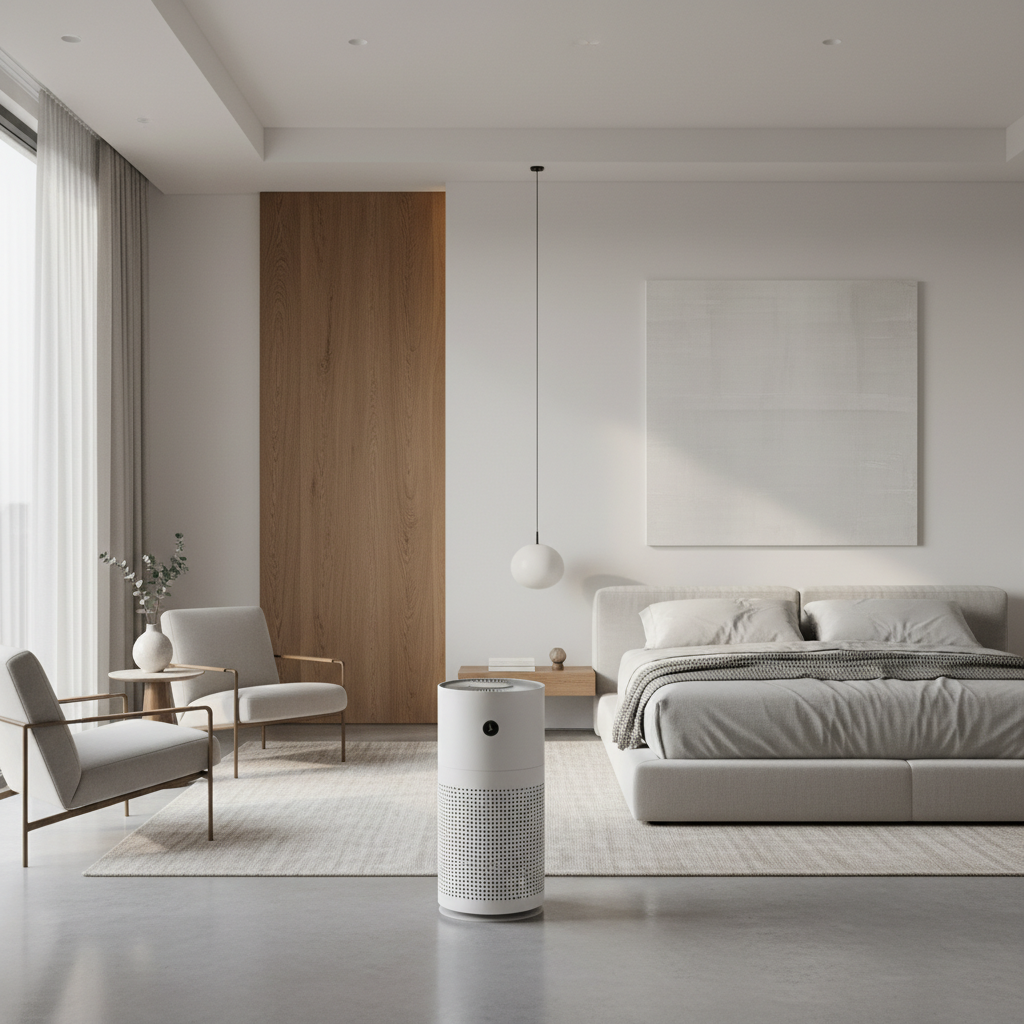
Placement rules that usually work (before you overthink the layout)
If you follow only a few rules, follow these. They cover the most common “why does this purifier feel useless” complaints.
- Keep clearance around the unit: many models need at least 6–18 inches from walls or furniture, but check your manual because intake design varies.
- Don’t hide it behind curtains or a nightstand: fabric and tight gaps can choke airflow and trap dust right where you’re trying to clean.
- Aim for the breathing zone: placing it within a few feet of the bed often helps, as long as the airflow is not pointed directly at your face.
- Stay off thick carpet when possible: a small stand or hard surface can reduce blocked intake near the floor and make it easier to vacuum around.
- Keep doors in mind: if the door is open most nights, you’re cleaning more than one room, which may reduce perceived results.
If you’re sensitive to noise, prioritize a spot where you can run a quieter setting all night. A “perfect” location that forces you to shut it off at 2 a.m. is not really perfect.
Best spots by bedroom scenario (quick guidance you can actually use)
Most bedrooms fall into a handful of layouts. Use these as starting points, then adjust based on comfort and airflow.
Small bedroom (10x10 or similar)
- Place the purifier 2–5 feet from the bed, with the clean-air outlet aimed across the room rather than at your pillow.
- Give it at least one “open side” so it’s not boxed in by dresser, bed frame, and wall.
Medium to large bedroom
- Put it between the bed and the main dust source (often a closet area, exterior window, or the doorway).
- If you have a sitting area, avoid placing it so far away that the bed is an afterthought.
If allergies hit hardest at night
- Bias placement toward your headboard area, but keep airflow indirect to avoid dry eyes or throat irritation.
- Run it on a steady low/medium setting rather than “auto” if auto mode keeps idling too low.
If the issue is odor (pets, cooking smell drifting in, mustiness)
- Place it closer to the path odors travel, often near the door or hallway side of the room.
- Remember that carbon performance depends on filter design; placement helps, but it won’t replace fixing the source.
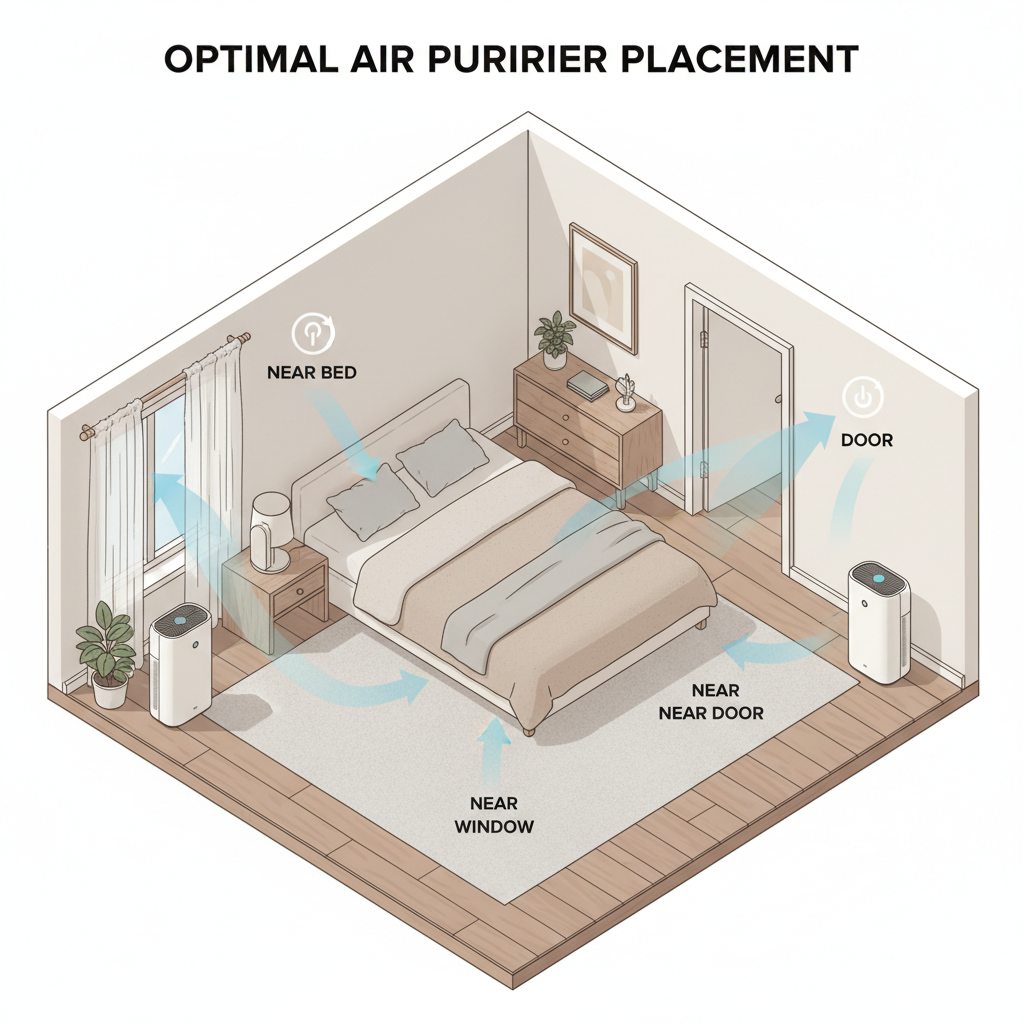
A simple self-check to confirm your placement is working
You don’t need lab gear to tell if you’re close. This quick check catches most real-world issues.
- Airflow check: hold a tissue near the intake area, it should pull gently and consistently (not “dead”).
- Draft check at the pillow: if you feel steady wind on your face, rotate the unit or move it a foot or two away.
- Noise check: can you keep it running all night at a meaningful speed, or do you keep turning it down?
- Dust pattern check (after a week): if dust still accumulates fast on the same surfaces, your purifier may be too hidden, too small, or you may need better housekeeping around textiles.
- Door habit check: if the door stays open, treat it like a larger zone, which can require a higher CADR or a second unit.
According to AHAM (Association of Home Appliance Manufacturers), CADR is a common way to compare how quickly a purifier can clean the air for smoke, dust, and pollen, so if your room size and the purifier capacity don’t match, placement tweaks only get you so far.
Use this table to choose distance and position (without guesswork)
These ranges are practical starting points for many bedrooms. Your model’s intake/outlet design still matters, so treat this as guidance rather than a strict rule.
| Bedroom situation | Recommended placement | Distance from bed | Why it helps |
|---|---|---|---|
| Allergy-prone sleeper | Near headboard side, outlet aimed across room | 2–5 ft | Targets breathing zone without direct draft |
| Light sleeper (noise sensitive) | Farther from pillow, clear path for airflow | 5–8 ft | Less perceived noise while still circulating air |
| Odor drifting in from hallway | Closer to door/hallway side | 4–8 ft | Intercepts odor path before it spreads |
| Room has a ceiling fan | Not directly under strong downdraft | 3–8 ft | Avoids turbulent airflow that can reduce efficiency |
| Purifier on thick carpet | Use a stable platform or hard surface area | Varies | Prevents intake blockage near floor |
Step-by-step: how to arrange air purifier in bedroom for best effect
If you want a repeatable process, this is the one I suggest. It keeps you from endlessly “trying random spots” and hoping.
- Step 1: Identify the main constraint: noise, space, draft comfort, or odor entry.
- Step 2: Choose one candidate spot with good clearance, not hidden by furniture.
- Step 3: Run the purifier for 24–48 hours on a steady setting you can tolerate overnight.
- Step 4: Adjust by small moves, 12–24 inches at a time, watching for better comfort and less dust/odor.
- Step 5: Lock in the location, then focus on habits: keep the filter schedule, vacuum textiles, and manage door/window use.
When people ask how to arrange air purifier in bedroom for best effect, the overlooked part is Step 3: consistency. A “test” that runs for two hours on high and then stays off for the night rarely tells you anything useful.
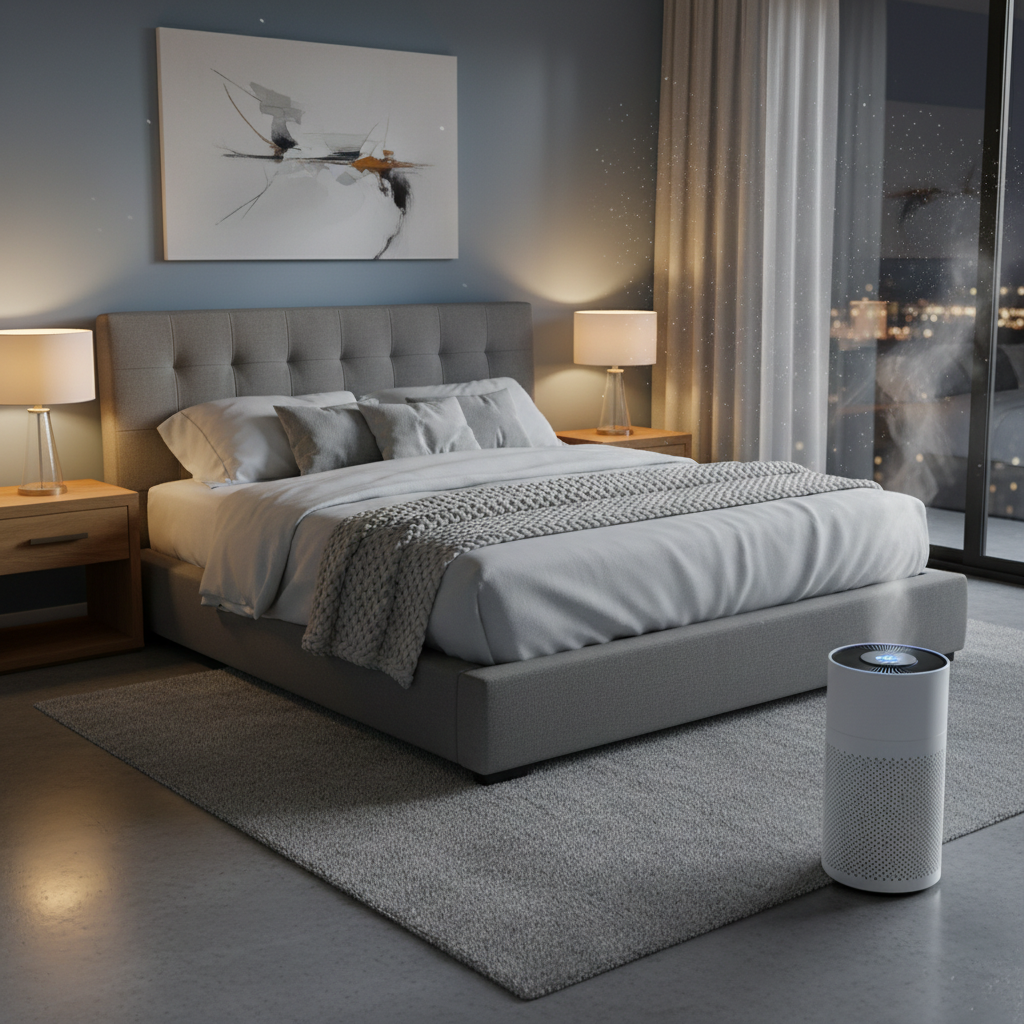
Common mistakes that quietly reduce performance
- Corner parking: corners feel tidy, but many units perform better with open space, especially if intake sits on multiple sides.
- Assuming “auto” always works: some sensors react more to larger particles or odors than to fine allergens, so the fan may stay low.
- Putting it right next to the headboard: you might get clean air, but also draft, noise, and disrupted sleep.
- Ignoring the filter condition: a loaded pre-filter can reduce airflow, and a saturated carbon stage can stop helping with smells.
- Cleaning the wrong room size: if the unit is undersized, the best placement still feels underwhelming.
According to the CDC, improving indoor ventilation can help reduce airborne contaminants in many settings, so if your bedroom is stuffy, pairing a purifier with better ventilation habits often matters as much as moving the unit around.
When to change your setup (or ask a professional)
Placement solves a lot, but not everything. Consider a different approach if any of these sound familiar.
- Persistent musty smell or visible damp: could point to moisture or mold issues, which typically need remediation guidance from qualified professionals.
- Asthma, severe allergies, or unexplained symptoms: it may be worth discussing indoor triggers with a clinician or allergist, since a purifier is only one layer.
- Smoke exposure: wildfire smoke or heavy secondhand smoke often requires tighter sealing, ventilation strategy, and a purifier with sufficient capacity for your room.
- Very open floor plan behavior: if you keep the bedroom door open to a large area, a single small-room unit may not keep up.
Key takeaway: if you can’t run the purifier consistently at a meaningful speed because of noise or draft, the “best” location is the one that lets you keep it on.
Practical wrap-up and what to do tonight
Good placement is usually simple: give the purifier space, keep it out of corners, and bias the clean-air stream toward the bed without aiming it at your face. If you remember only one thing, remember this: how to arrange air purifier in bedroom for best effect is less about a perfect spot and more about steady overnight use with unblocked airflow.
Tonight, pick one location 2–5 feet from the bed with clear clearance, run a steady setting you can sleep through, then reassess after two nights before you move it again.
FAQ
Where should I place an air purifier in a bedroom with a ceiling fan?
Keep it out of the strongest downdraft so it can form a stable circulation pattern. Many rooms do fine with the purifier a few feet off to the side of the bed, not centered directly under the fan.
Is it okay to put an air purifier right next to my bed?
It can be, but many people end up annoyed by draft or noise. A small gap, even 2–3 feet, often feels better while still keeping the breathing zone cleaner.
Should the purifier face the bed or face away?
If the outlet stream feels like a fan on your face, angle it away or across the room. You’re aiming for mixing and coverage, not a direct blast at your pillow.
Does opening the bedroom door reduce effectiveness?
Usually yes, because you’re increasing the area the purifier is “responsible” for. If you prefer sleeping with the door open, you may need a higher-capacity unit or accept slower cleanup.
How high off the floor should a bedroom air purifier be?
Many purifiers are designed for floor placement, but thick carpet and blocked intake can be a problem. If airflow seems restricted, a low, stable platform can help, as long as it doesn’t block vents.
How long should I run the purifier at night for noticeable results?
For bedroom comfort, most people run it through the night. If noise is the limiter, a consistent low/medium setting often beats short bursts on high that you turn off.
How do I know if my purifier is too small for my bedroom?
If you’ve tried sensible placement, keep doors/windows consistent, and still notice lingering odors or symptoms, capacity may be the issue. Checking the recommended room size and CADR guidance from the manufacturer can clarify.
If you’re trying to improve sleep comfort and you’d rather not guess, a simple next step is to measure your room, confirm the purifier’s room-size rating, then set up one “bed-focused” placement and stick with it for a couple nights before making changes.